Mortgage rates are under pressure from inflation and energy costs, expectations for the economy and Federal Reserve policy, and the return investors demand to own long-term bonds. Sustained cooling in inflation, weaker economic growth, or stronger bond demand could help rates fall. None provides a guaranteed timetable.
That’s the useful answer.
The less useful answer is “Nobody knows.” Accurate, but tough to build a business plan around.
Buyers are nervous. Realtors are nervous. Loan officers are checking the bond market like it owes them money.
Which, in a way, it does.
On this page
What is happening with mortgage rates?
The 10-year Treasury rose from 4.75% on August 31 to 5.29% on September 30—more than half a percentage point in a month. U.S. Treasury
Freddie Mac’s latest weekly average available when this article was prepared was 7.03% for a 30-year fixed mortgage on September 24, up from 6.95% the previous week. That is a national benchmark, not an individual loan quote. Freddie Mac
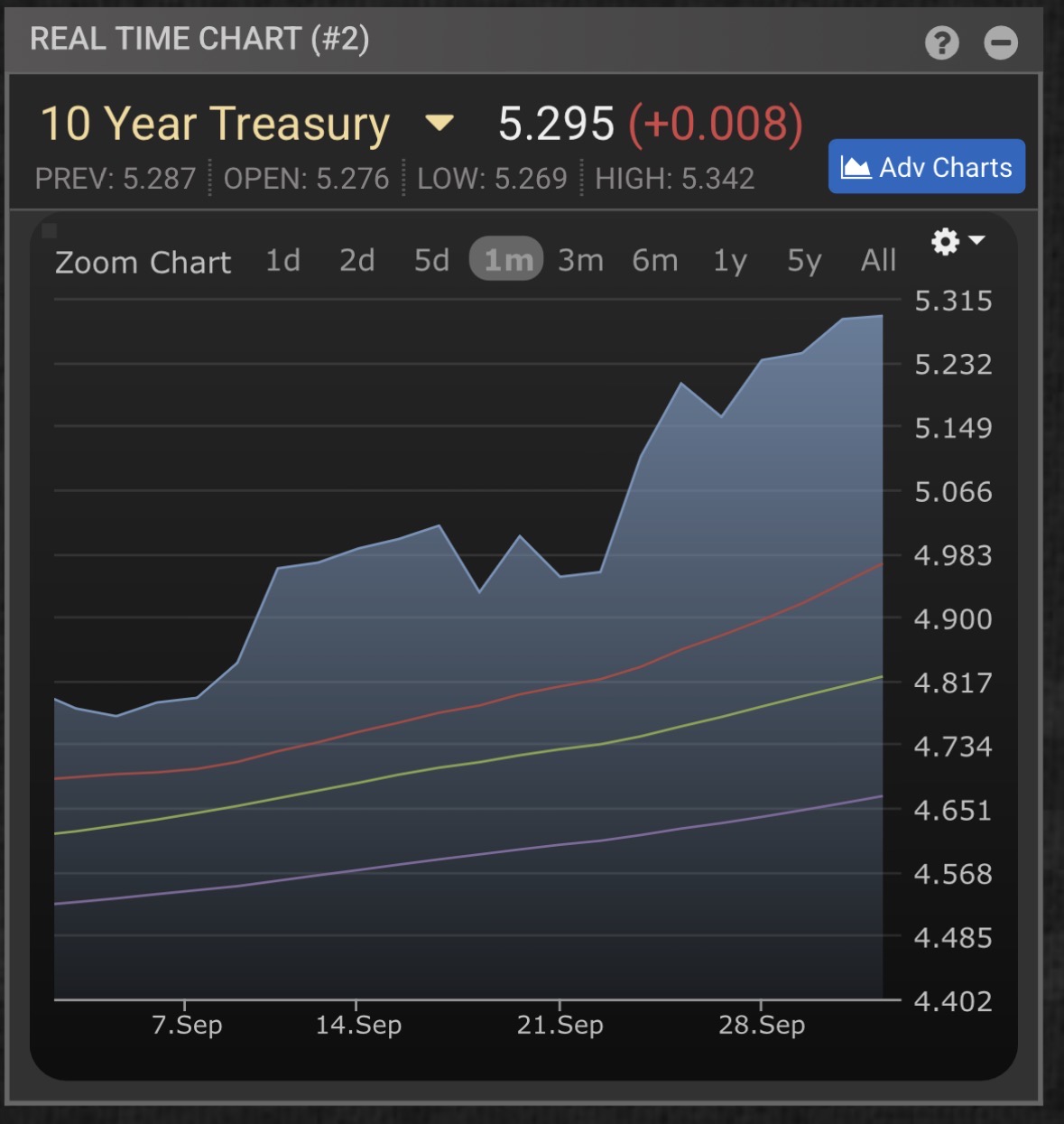
Screenshot supplied by Adam Styer; shows 5.295% at capture, not a live quote. The capture time and additional indicator lines are not identified.
Everyone wants to know where rates go next.
I’d love to tell you. Unfortunately, my crystal ball apparently has the same accuracy as everyone else’s.
A better question: What would have to happen for mortgage rates to improve?
Why are mortgage rates rising?
Three broad forces help explain the pressure.
Inflation, energy, and geopolitical risk. Higher energy costs can make shipping, production, and everyday goods more expensive. Recent oil-price swings tied to the Iran conflict have contributed to pressure on Treasury yields. Earlier in this move, I thought easing energy pressure might be the thing that finally gave us relief. It still matters—but it isn’t the whole story. Associated Press
The economy and the Fed. A resilient economy gives the Fed less reason to lower rates. In September, the Fed raised its benchmark rate by a quarter point, citing elevated inflation and solid economic activity. Federal Reserve
The bond market itself. The government sells Treasuries to borrow money. Investors decide what return makes that worthwhile. Bond supply, investor demand, and uncertainty all matter. Investors may require extra compensation for holding long-term debt—the “term premium.” Federal Reserve Bank of New York
Translation: one encouraging inflation report doesn’t automatically make investors eager to lend money cheaply for ten years.
How does the 10-year Treasury affect mortgage rates?
Mortgage rates are priced through mortgage-backed securities. The 10-year Treasury is a useful reference because both respond to many of the same economic and bond-market forces.
A rough shortcut is the 10-year Treasury plus about two percentage points. It is a temperature check, not a pricing formula.
On September 24, Freddie Mac’s 7.03% average and the Treasury’s 5.18% reading were about 1.85 percentage points apart. Those measurements have different timing, so the comparison is approximate.
Here’s my operating framework—not a forecast or a set of magic thresholds:
| 10-year Treasury yield | What I’m watching for |
|---|---|
| Below 4.90% | Meaningful relief compared with today |
| 4.90%–5.30% | Continued pressure on buyer payments |
| 5.30%–5.60% | Increasing risk of buyers stepping back |
| Above 5.60% | Broader strain from expensive borrowing |
Direction and staying power matter. Briefly touching a number doesn’t change a buyer’s budget.
What would make mortgage rates fall?
Sustained improvement in inflation, lower energy pressure, slower economic growth, or stronger demand for long-term bonds could help bring rates down.
This explains why weaker economic news can sometimes help mortgage rates: investors may buy bonds and expect lower future interest rates. Nobody needs to root for a recession to understand the connection.
High rates can also contribute to their own eventual reversal. Expensive financing slows purchases, spending, and investment. That slowdown can help push yields lower.
“Eventually” is doing a lot of work in that sentence. There is no guaranteed timetable.
Will high mortgage rates make home prices fall?
High rates can pressure prices, but falling prices are not the only possible adjustment.
Housing can also adjust through seller concessions, builder incentives, longer marketing times, less competition, or fewer transactions.
It won’t look the same across every Texas market. Sellers’ expectations and buyers’ budgets have to find a place to meet.
For some buyers, that could create an opening.
Where is the business if rates stay high?
Waiting for 5% mortgages is not much of a business plan. Believe me, I’d love for it to work.
I’m focusing on people who still have a reason to act:
Investors looking for deals. Homeowners carrying expensive renovation debt. People who need equity but don’t want to touch their 3% mortgage. Self-employed buyers whose tax returns don’t tell the whole story.
DSCR, cash-out, HELOCs, and alternative-income programs give me ways to explore those scenarios. The numbers still have to work.
Construction has also been one of my most consistent lead sources. Someone casually browsing houses can wait. Someone who spent two years buying land and designing their dream kitchen may be more committed.
You don’t need a dissertation on the products. Just know there may be another way to get a scenario done.
How should Realtors talk to buyers about rates?
Start with the payment and the buyer’s circumstances.
Someone who genuinely cannot afford today’s payment needs a workable budget, not pressure. Someone who can afford it but feels nervous needs help evaluating the choices. Someone certain rates will be lower next year needs a friendly reminder that nobody knows.
A natural way to explain it:
“I can’t promise where rates will be next year. Let’s figure out what payment works for you and what would need to change to get there.”
That gives you something useful to monitor. No promised refinance required.
Still standing—and better
There’s an old Chinese farmer story where everyone labels each new event good or bad. His answer: “Maybe.”
Higher rates hurt. The consequences are real. What they ultimately lead to is less certain.
So I’m spending less energy predicting the market and more energy figuring out how to work in it.
Stay close to your database. Talk to investors. Revisit stalled scenarios. Know the payment that gets each buyer moving.
I don’t know when this market turns. My goal is to still be standing—and better—when it does.
We can’t control the 10-year Treasury. We can control who we call, how well we follow up, and whether we know another way to solve the problem.
Frequently asked questions
Does a Fed rate cut automatically lower mortgage rates?
No. The Fed controls a short-term benchmark rate. Mortgage rates also reflect long-term bond yields, inflation expectations, and conditions in the mortgage-backed securities market.
Can mortgage rates fall without a Fed rate cut?
Yes. Mortgage rates can improve if bond-market conditions improve, even before the Fed changes its benchmark rate.
Should buyers wait for lower mortgage rates?
That depends on their budget, timeline, and available homes. Waiting does not guarantee lower rates or a lower total purchase cost. A useful starting point is the monthly payment they can comfortably afford.
Can homeowners access equity without refinancing their first mortgage?
Potentially. A HELOC or separate home equity loan may allow that, subject to qualification and available equity. Rates, costs, and repayment terms need review.
Have questions? Want to know what your options look like right now? Give me a call or shoot me a text. Happy to run the numbers for you.
Talk soon,
Adam Styer
Adam Styer | HyperSmart Home Loans
NMLS# 513013 | (512) 956-6010